How To Create A Conscious Relationship: Why Healthy Love Requires Intention, Awareness and Doing the Work
Updated: May 13

There is a common misconception that healthy relationships happen naturally. That when two people are truly compatible, communication flows easily, intimacy remains effortless, and conflict somehow resolves itself without much intervention. It is a beautiful idea, but it is rarely the reality of long-term partnership.
The truth is that conscious relationships are not accidental. They are created.
In my work as a relationship psychotherapist and certified Imago Relationship Therapist, I often meet couples who deeply love one another, yet feel disconnected, misunderstood or emotionally exhausted. Many arrive believing something has gone wrong in the relationship itself. More often, what has happened is that the relationship has moved beyond the unconscious stage of love and into something deeper, more confronting and ultimately more meaningful.
This is where the real work begins.
Imago Relationship Therapy is grounded in the idea that we are unconsciously drawn to partners who reflect both the positive and painful aspects of our early relational experiences. We tend to choose people who feel familiar to our nervous system, even when that familiarity creates friction later on. This is not because we are trying to sabotage ourselves, but because relationships offer an opportunity for unfinished emotional experiences to surface and, importantly, to be healed differently.
Harville Hendrix speaks about relationships as moving through distinct developmental stages, rather than remaining emotionally static. This perspective can be deeply reassuring for couples who fear that conflict or disconnection means something has gone wrong. In reality, many relationships are simply moving from unconscious relating into a more conscious phase of growth.
The first stage is the romantic stage. This is often the period couples describe as effortless. There is fascination, chemistry, attentiveness and idealisation. During this phase, partners tend to focus heavily on pleasing one another.
The unconscious question becomes, “What can I do for you?” Couples are naturally more accommodating, emotionally available and eager to maintain harmony. Neurochemically, this stage is heavily influenced by attraction, projection and fantasy, which is why many people experience it as intoxicating. According to Hendrix, this phase generally lasts around six months, though emotional intensity can vary from couple to couple.
The second stage is the power struggle. This is often where couples begin to panic because the relationship no longer feels as easy or instinctive. Differences emerge more clearly. Old wounds become activated. Emotional needs that were previously hidden start demanding attention. Hendrix believed this stage reflects our unconscious attempt to heal unresolved experiences from earlier caregiving relationships.
The focus subtly shifts from “What can I do for you?” towards “What can you do for me?”
This stage can last years, and for some couples, even decades. It often involves criticism, defensiveness, emotional withdrawal, avoidance, stonewalling or living increasingly separate emotional lives. Many relationships end here because couples mistake the power struggle for incompatibility, rather than recognising it as an invitation into deeper awareness.
Yet if a couple is willing to stay engaged, reflect honestly, and learn new ways of relating, something important can begin to emerge.
The third stage is the conscious relationship. This is where couples begin working together for the good of the relationship itself, rather than purely from individual need or protection. There is greater emotional awareness, more intentional communication, and a growing capacity to remain connected even during moments of difference. Partners learn how to be separate individuals within the relationship while still staying emotionally attuned to one another and to the relationship they are consciously creating together.
A conscious relationship asks something very different of us than unconscious love.
It asks us to become aware of our reactions rather than simply acting from them. It asks us to communicate instead of assuming. To stay emotionally present during discomfort rather than withdrawing or escalating. Most importantly, it asks us to stop seeing our partner as the problem and begin understanding the dynamic itself with greater compassion and clarity.
Doing the work in a relationship does not mean striving for perfection. It means developing awareness around the patterns that quietly shape connection. Every couple develops relational habits over time. Some create closeness and safety. Others create distance, defensiveness and resentment. Without reflection, these dynamics become automatic.
This is often where couples begin to feel stuck.
Arguments repeat themselves with different wording but identical emotional outcomes. One partner pursues while the other withdraws. Misunderstandings become loaded with historical meaning. Emotional intimacy starts to feel harder to access. Couples can begin to live beside one another rather than truly with one another.
Within Imago Relationship Therapy, the goal is not simply conflict resolution. It is transformation through awareness.
One of the central principles of Imago is the creation of safety. Human beings do not open emotionally when they feel criticised, judged or emotionally threatened. They protect themselves. This is why communication in distressed relationships often becomes reactive rather than connective. Defensiveness replaces curiosity. Listening disappears. Couples stop hearing one another clearly because they are too focused on self-protection.
Creating a conscious relationship requires slowing this process down.
The Imago dialogue process is one example of this. Rather than interrupting, fixing or defending, partners learn to mirror and validate one another’s experience. This does not mean agreeing with everything being said. It means allowing space for another person’s reality to exist without immediately trying to change or correct it. For many couples, this is transformative because it reintroduces something they have often lost: the experience of feeling genuinely heard.
Conscious relationships also require accountability. Not blame, but accountability. There is a significant difference between understanding where our responses come from and using those experiences to justify hurtful behaviour. Doing the work means recognising our triggers, understanding our attachment patterns, and taking responsibility for how we show up in moments of tension.
Within Imago Relationship Therapy, there are also important relational commitments that support couples in moving from unconscious dynamics towards conscious connection.
The first is the decision to remove negativity from the relationship dynamic. This does not mean avoiding honesty or difficult conversations. It means becoming more intentional about tone, criticism, contempt and the ways emotional harm quietly enters communication. Couples begin learning how to speak to one another in ways that preserve safety rather than erode it.
The second is to recommit. Conscious relationships require ongoing choice. Recommitment is not about denying challenges, but about deciding to remain emotionally engaged in the process of growth together rather than retreating into avoidance or hopelessness.
The third is to reimage your partner. Over time, couples often become fixed in old perceptions of one another. Reimagining involves becoming curious again. Seeing your partner not only through historical frustrations, but as a changing, evolving human being with emotional depth, fears, needs and potential.
The fourth is to reframe frustrations. In Imago work, frustrations are not viewed purely as problems to eliminate. They are often seen as information. They can reveal unmet needs, attachment wounds, differences in communication styles, or opportunities for healing and growth within the relationship itself.
The fifth is to reromanticise and revision the relationship. Looking towards the future shifts the energy from the negative voids and thinking towards what is possible and positive thoughts.
Long-term relationships require intentionality. Romance rarely sustains itself without attention. Couples are encouraged to consciously create experiences of connection, affection, novelty and emotional intimacy while also revisiting the shared vision of the relationship they want to build together moving forward.
Importantly, conscious relationships are not devoid of conflict. In fact, conflict often becomes the pathway into greater intimacy when approached differently. When couples learn how to stay emotionally present during moments of difference, rather than moving into criticism or shutdown, they begin to experience conflict as something connective rather than destructive.
This shift changes the emotional atmosphere of the relationship entirely.
Emotional safety increases. Vulnerability becomes more accessible. Physical intimacy often improves because emotional closeness feels safer again. Couples stop trying to win and start trying to understand.
In many ways, doing the work in a relationship is less about changing your partner and more about becoming more conscious within yourself. Relationships naturally expose our sensitivities, fears, unmet needs and emotional defences. The question is whether we meet those moments unconsciously, or whether we use them as opportunities for growth.
Conscious relationships require intention because modern life constantly pulls couples away from presence. Stress, work, parenting, technology and emotional fatigue all compete for attention. Without intentional connection, couples can slowly drift into functionality rather than intimacy. They become efficient partners, but emotionally disconnected lovers.
The work, therefore, is ongoing. It is choosing communication over assumption. Repair over avoidance. Curiosity over criticism. Presence over distraction.
And while this work can feel challenging at times, it is also what creates depth.
The healthiest relationships are not the ones without difficulty. They are the ones where two people are willing to keep returning to each other with honesty, awareness and openness, even when it would be easier not to.
A conscious relationship is not built in a single conversation or breakthrough moment. It is built slowly, through repeated acts of emotional courage, accountability and connection.
If you are feeling disconnected in your relationship, repeating the same patterns, or wanting to create a more conscious and emotionally connected partnership, relationship therapy can offer a safe and structured space to begin that work together.
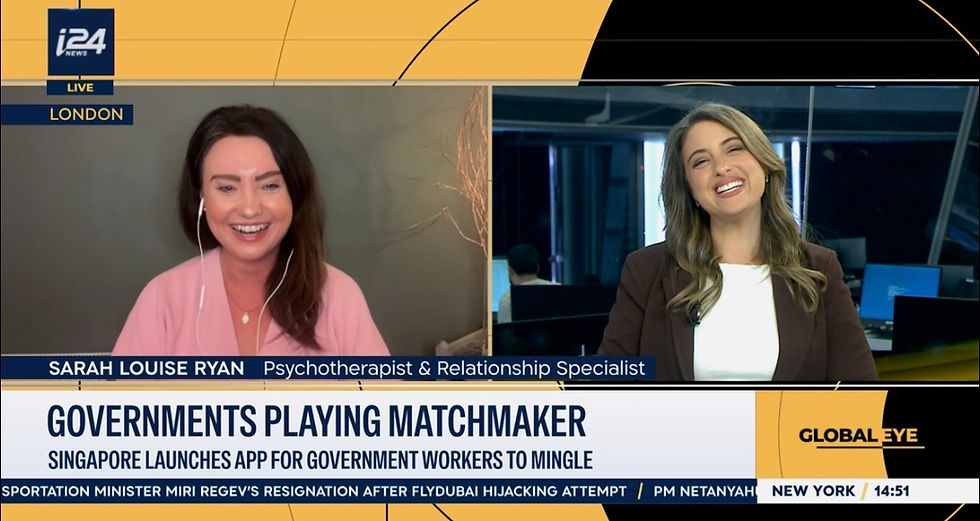
I’m Sarah Louise Ryan, a relationship psychotherapist specialising in working with individuals and couples online and in person. I am a certified Imago Relationship Therapist, currently advancing in my clinical practice - training as a Supervisor for Imago Relationship Therapists, and also as a Getting the Love You Want workshop presenter in the UK.
My work is grounded in helping couples move beyond unconscious relational dynamics and towards greater emotional safety, communication, intimacy and conscious connection. Together, we explore the patterns shaping your relationship, deepen understanding, and create practical ways to reconnect with one another in more intentional and meaningful ways.


Comments